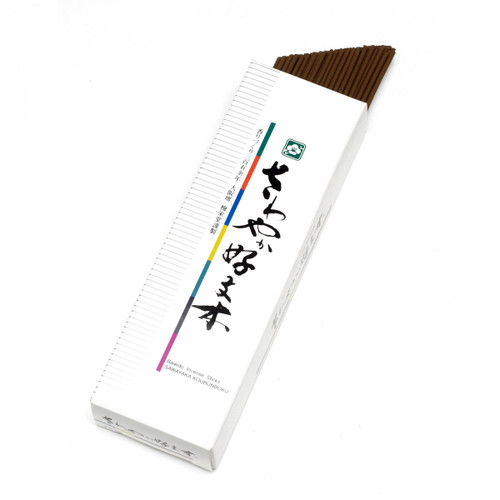


Incense weight: 80 grams
Number of sticks: Approximately 85 long sticks. This may vary slightly though as the quantity of incense is based upon weight, not the number of sticks
Stick length: Approx 25 cms
Burn time per stick: One hour or a little more
Manufacturer: Baieido, Japan
They say: Kobunboku is an expression of the Plum Tree. The flower is well known as 'The flower of peace' from ancient China. Kobunboku is a wonderful mixture of sandalwood & herbs, especially good for meditation and relaxation.
These sticks are made from pure formed incense. There is no stick running through the centre.
About sandalwood: An evergreen tree of the Santalaceae family found predominantly in India. Within India, the area by the southwest coast known as the Mysore region is referred to as Sandalwood City, and this is regulated by the Indian government. It is extremely famous for its production of superior quality Sandalwood as well as its high price. The heartwood of the Sandalwood tree has been valued from ancient times for carving Buddhist statues and ritual objects. Its aroma is proclaimed of in ancient works as; 'pure, powerful, emanating tranquility, when burnt it is superior to other incense aromas.'
Long or short stick? The only difference between the long and short stick is the length, and correspondingly the time they burn for. Generally long sticks burn for about an hour whereas short sticks burn for about half and hour. So long sticks are good if you are meditating for longer periods, or wish the stick to burn for a longer period. Long sticks can also easily be broken in half for times when you don't want them to burn so long though.
More About Baieido Incense
Baieido is one of the oldest traditional incense producers in Japan and has been producing a range of pure and high quality incense for over 300 years. The company has a long history, which can be traced back to the Muromachi period in Japanese history (1338 to 1573). The founder of Baieido, Kakuuemon Yamatoya, became a wholesaler of medicinal herbs in Sakai city during this time. It was a well known trading port, where demand for good quality incense was high. By 1657, Kakuuemon Yamatoya was specialising in selling incense ingredients and incense sticks and was able to call himself Jinkoya Sakubei. Jinkoya meant ‘aloeswood trader,’ and it was a name that only authorised medicinal wholesalers, who specialised in incense, in Sakai were able to call themselves.
Later the name of the business changed to Nakata Baieido, still making incense with methods that had been handed down for generations. Baieido is now recognised as one of the highest quality incense manufacturers in the world today blending the finest aromatic woods and resins to produce a natural, mild, low-smoke incense stick of superb quality and aroma. Since Jinkoya’s incense work, the time-honoured traditions and incense formulas have passed on down through the centuries and the company continues to make incense to the oldest recipes. Baieido take pride in using both traditional incense stick making processes alongside more modern manufacturing techniques and new technology.
About Japanese Incense - High quality, pure
Japanese incense (speaking in general terms) is refined, pure, light smoke and rich in natural ingredients such as sandalwood. They don't usually have the thin wooden stick centre that is often found in Indian and other incense sticks. They are normally pure incense right the way through the stick. They are often designed with meditation in mind. Due to the high quality manufacturing processes the incense goes through they can be a little bit more expensive than other incense on the market.

To find out more read:
The History of Japanese Incense
Staff Review by Brett Almond
In the packet these sticks smell exotic, sweet and a little bit spicy. Once lit the aroma is beautifully delicate and the smoke can be seen when burning but it is very light. This incense is great for those who would love to burn incense if it wasn't so smokey! This is the first incense many people think of when they think of Baieido as it is one of their best selling products. It is renowned for its use while meditating.
When we first received this incense I burnt one stick in my office and when I came in the next day the smell was still gently lingering. It wasn't a smokey smell at all. It was a gentle sweet, slightly spicy aroma that was really welcoming and relaxing. Personally I now love the Japanese incense from Baieido for burning around the house or office and for when meditating. This is a premium sandalwood and herb incense. There are other incenses from the kobunboku range (called Tokusen and Kaden). The difference is that they have varying quantities of aloeswood added also. As aloeswood is very much a premium ingredient this makes these other two more expensive.
UK Royal Mail Tracked 48 – Flat charge £3.50, or free on orders over £40
Order by 3pm Monday - Friday (excluding public holidays) for same day dispatch. Delivery after dispatch is 2-3 working days.
UK Royal Mail Tracked 24 – Flat charge £4.70, or £1.70 on orders over £40
Order by 3pm Monday - Friday (excluding public holidays) for same day dispatch. Delivery after dispatch is 1-2 working days.
UK Special Delivery Royal Mail by 1pm next working day – from £9.80
Order by 3pm Monday - Friday (excluding public holidays) for same day dispatch. No delivery at weekends or bank holidays, orders dispatched on Friday will be delivered on Monday. A signature is required. The exact price is based upon the weight of items in the basket.
INTERNATIONAL DELIVERY
Choose between Royal Mail post (cheaper and slower) or DHL (more expensive and faster).
• Royal Mail to Europe 3-6 working days after dispatch - from £4.20 (2 kg max.)
• DHL to Europe from 1-2 days after dispatch - from £19.96.
• Royal Mail to Outside Europe 6-10 working days after dispatch - from £6.48 (2 kg max.)
• DHL to Outside Europe from 1-2 days after dispatch - from £25.00.
Order by 3pm for Royal Mail and 12 midday (Monday – Friday) for DHL, for dispatch on that
day (Excludes public holidays). Exact price and transit time based on combination of
destination and weight of parcel.
RETURNS INFORMATION
We accept returns of unopened / unused products within 60 days, please refer to our FAQ page for more information on this.